
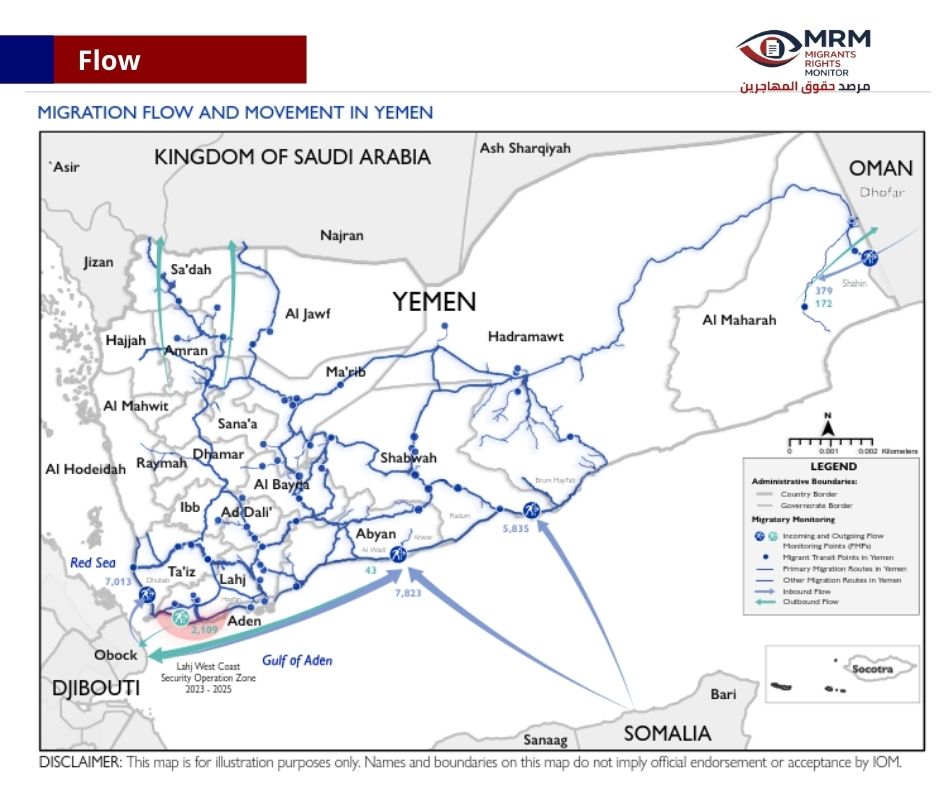
Recent data from the International Organization for Migration (IOM)’s Displacement Tracking Matrix (DTM) indicate notable shifts in migration patterns to Yemen, particularly in the demographic composition of arrivals and the growing concentration of flows along specific coastal areas—most prominently in Abyan governorate.
According to IOM’s January 2026 report, 21,050 migrants entered Yemen, marking a slight 4 per cent decrease compared to December 2025, when 21,996 arrivals were recorded. Despite this modest decline in overall numbers, a more significant trend is the continued rise in the proportion of vulnerable groups within these flows.
The data show that 65 per cent of arrivals were men, 16 per cent were women, and 20 per cent were children. This means that more than one-third of those arriving in Yemen are women and children. Commenting on this development, Nahla Al-Maqtari, researcher at the Migrant Rights Observatory, stated:
“This is a development that requires special attention given the grave risks these groups face in the context of irregular migration, particularly in a country affected by armed conflict and a complex humanitarian crisis.”
In terms of departure points, approximately 66 per cent of migrants departed from Djibouti, 32 per cent from Somalia, and 2 per cent from Oman. Regarding entry locations, Abyan governorate received the largest share of migrants arriving from Djibouti, followed by Ta’iz. All migrants departing from Somalia arrived in Shabwah governorate, while 379 migrants from Oman entered through Shahin district in Al Maharah governorate.
Abyan—especially its coastline stretching from Shaqra to Ahwar—is increasingly emerging as a primary landing zone and, according to field observations, a relatively safe haven for smuggling and human trafficking networks. Based on IOM-linked monitoring data, approximately 8,000 migrants arrived in Abyan during January alone, most of them Ethiopian nationals. The heavy concentration of arrivals in this specific coastal corridor raises serious concerns about the expanding influence of smuggling networks amid limited oversight and fragile protection mechanisms.
At the same time, IOM recorded 2,324 migrants departing Yemen in January, the majority returning voluntarily to Obock, Djibouti, primarily from Lahj governorate, while others departed from Al Maharah toward Oman. Although this reflects the continuation of voluntary return movements, the figure remains relatively low compared to the number of new arrivals, indicating that increasing numbers of migrants remain stranded inside Yemen.
The growing proportion of women and children, combined with the geographic concentration of arrivals in vulnerable coastal areas such as Abyan, underscores the urgent need to strengthen protection mechanisms, support host communities, and intensify efforts to combat smuggling and trafficking networks. Migration to Yemen is not merely a transit movement—it is a recurring humanitarian emergency that demands greater international attention and a stronger focus on protecting the most vulnerable.



Leave a Reply